

What is Bird Feeders
A bird feeder, bird table, or tray feeder is a device placed outdoors to supply bird food to birds (bird feeding). The success of a bird feeder in attracting birds depends upon its placement and the kinds of foods offered,as different species have different preferences.Bird feeders offer a fun and entertaining way to observe birds up close and connect with nature. They also supplement the natural food sources available for birds in your yard or garden. Different species of birds prefer varying types of feeder foods. Nourishment for wildlife should come primarily from natural food sources such as native plants. Feeders should only be supplied to complement birds' natural diets.




Why Choose Us
Our Product
Grow your own kit, garden gloves, bird care, garden decoration, garden accessories and tools, irrigation, etc.
Our Service
OEM and free design artwork service. 1-2 years products guarantee depends on different products.
Our Factory
Hangzhou Aiolos Homeware Co., Ltd is our own factory which can do package and vacuum forming products. We are able to offer Phytosanitay Certificate for seeds and coco coir peat in grow kit. We are BSCI audited factory and owns ISO 9001:2015 quality managerment system certificate. Big storage warehouse 9000㎡.
Certifications
We have our own warehouse and packing line as well as certificates like CE, BSCI, Sedex and so on. We also can accept OEM. It's our keen to develop more products and business all over the world. We are member of SEDEX and FSC. Our company also owns ISO 9001:2015 quality managerment system certificate.
Types of Bird Feeders
Tray Or Platform Feeders
Trays attract the widest variety of seed-eating feeder birds, including pigeons, starlings, and House Sparrows, but also grosbeaks and native sparrows. Tray feeders offer no protection against rain and snow; without excellent drainage, seeds may become wet enough to sprout, and wet seeds may also foster fungal and bacterial growth. Bird droppings can quickly soil the seed in tray feeders. The best tray feeders have a screened, rather than solid, bottom to promote complete drainage; at the very least, tray feeders should have several drainage holes. Even with drainage, the bottom should be removable for fairly frequent hosing. Offer only enough seed in tray feeders for birds to finish every day or two, and shake out the bottom every time you add new seeds.
Hopper Or “House” Feeders
This kind of feeder protects seeds fairly well against the weather and bird droppings, but if the seed within the hopper does get wet, bacteria and fungus can thrive. Hopper feeders are attractive to most feeder birds, including finches, jays, cardinals, buntings, grosbeaks, sparrows, chickadees, and titmice; they're also squirrel magnets. Many hoppers can hold enough seed to last for several days, which can make them very convenient for people, but dangerous for birds if the seed within is allowed to get wet. Most hopper feeders are much harder to clean than tray feeders. Hopper feeders can be mounted on a pole or suspended. Again, a squirrel baffle is important if you don't want to feed them.
Window Feeders
Small plastic feeders affixed to window glass with suction cups, and platform feeders hooked into window frames, attract finches, chickadees, titmice, and some sparrows. They afford us wonderful, close-up views of birds, and their placement makes them the safest of all feeder types for preventing window collisions. Because many birds feed while standing on the seeds in window feeders, the food risks becoming soiled, so the seed in these feeders should be changed daily and the feeders kept very clean. Fortunately, for most window designs these are the easiest of all feeders to access for filling and cleaning.
Tube Feeders
Hollow tubes keep seed fairly clean and dry and, if they have metal feeding ports, may be somewhat squirrel resistant (though squirrels often chew through the end caps or the plastic tube itself). Depending on the size of the perches under the feeding ports, you may attract small birds such as sparrows, grosbeaks, chickadees, titmice, and finches while excluding larger species such as grackles and jays. Styles with perches above the feeding ports are designed for seed-eating birds that can feed hanging upside down, such as goldfinches and chickadees, while dissuading others. Depending on the size of the feeding ports, you can offer tiny nyjer seeds or larger seeds.
Nyjer Feeders
Nyjer (also called thistle) feeders are especially popular with American Goldfinches, Pine Siskins, and Common Redpolls. They come in two forms—tube feeders with very small feeding ports, and “thistle “socks”—fine-mesh bags to which birds cling to extract the seeds. The seed within thistle socks can become quite wet with rain, so only use large ones during periods when you have enough finches to consume the contents in a few days. The same caveats are true of nyjer tube feeders as other tube feeders.
Suet Feeders
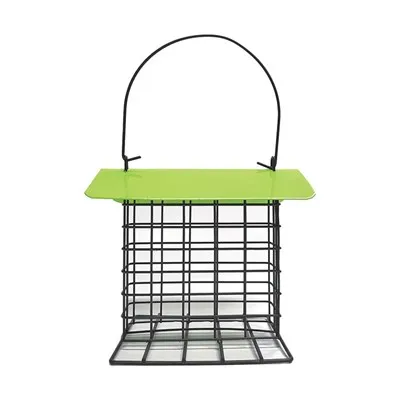
Suet feeders may be constructed of wire mesh or plastic-coated wire mesh, or be a simply mesh onion bag. They can be nailed or tied to a tree trunk, suspended, or affixed to the side of a hopper feeder.
Suet feeders attract a variety of woodpeckers, nuthatches, chickadees, titmice, jays, and starlings. Suet cages that open only at the bottom force birds to hang upside down while feeding. This design usually excludes starlings, which have trouble perching that way.
Some people are concerned about metal suet feeders, afraid bird tongues or eyes can stick to the metal. Although anecdotal information about this actually happening is scarce or nonexistent, it's easy to find plastic-coated suet cages.
Materials Used in Bird Feeders

Metal bird feeders
If you're looking for sturdiness and durability, a metal bird feeder can be a great choice. We love them because they also make solid fortresses against assaults from opportunistic squirrels!
These feeders need cleaning just like any other, so it's important you choose one with easy access to all the places you'll need to freshen up.
The Eco-Friendly Premium Bird Seed Feeder . It has a locking lid to keep the squirrels out, and you can release the whole base to make regular cleaning a breeze.
Wooden bird feeders
Wooden bird feeders look great in your garden, but there are a few things to keep in mind when you opt for one.
To start with, they might need weatherproofing if you want them to last. There are plenty of wood treatments to choose from, but it's essential to check they'll be safe around wildlife first. (Once everything's dried, that is. Please don't start weatherproofing while the birds are still having lunch!)
Also, you'll want to steer clear of bleach when you're cleaning your wooden bird feeder. This can leave a permanent smell which isn't healthy or attractive to your feathered visitors.
Wooden feeding tables and ground feeders can be brilliant for brightening up your garden; you can keep the birds safe while they're feeding by placing a metal ground guard over the latter. Many of these have holes too small for squirrels but which are the perfect size for species like robins to fit through.

The Best Place to Hang a Bird Feeder
Makes the birds feel safe from predators. Above all else, the location of your bird feeder should make the birds feel safe and at home! Birds will not eat from a bird feeder where they feel vulnerable. Place your bird feeder near natural cover like trees, shrubs, or other vegetation. This gives them shelter while viewing their feeding area so they can see any predators while waiting for their turn to feed.
You can see from inside your house. The best thing about having bird feeders in your backyard is that you get to enjoy birdwatching from your own home! Think about where you spend your time both indoors and out. Walk around inside your house and position yourself in the spots you spend the most time in. You'll want to choose a location where you can easily view your feeder through a window to get the most enjoyment out of it.
Is in a convenient location. If you're in a location with seasonal weather patterns and you plan to feed the birds throughout the winter months, you may want to choose a location that you won't mind walking to in undesirable weather.
Prevents pests from easily reaching the seed. There's nothing more frustrating than seeing unwanted critters eating the seed that's meant for your birds! Remember to keep your bird feeders roughly 10-12 feet from any tree or obstacle to deter unwanted pests from reaching the seed. (We do not recommend hanging bird feeders from tree branches as this can give squirrels and pests easy access to the feeder content.) If you'll be placing your bird feeder in an area with lots of squirrel activity, a baffle can be used to prevent squirrels or other pests from climbing up a pole or jumping down onto the feeders from above.
How to Make Bird Feeders


- Choosing the Right Materials
When making a homemade bird feeder, selecting the right materials is crucial. You want to choose materials that are durable, weather-resistant, and safe for the birds. In this section, I will discuss two important factors to consider when selecting materials for your bird feeder: durability and recyclability.
When choosing materials for your bird feeder, you want to make sure they are strong enough to withstand the elements and the birds. Untreated wood, such as cedar or pine, is a popular choice for its durability and bird-friendly nature. Not only is it sturdy, but it also provides a natural look that blends in well with the environment. You can also use plastic bottles or yoghurt pots, which are lightweight and easy to clean.
- Designing Your Bird Feeder
When designing your bird feeder, it is important to consider the structure. The feeder should be sturdy enough to withstand the weight of birds and their movements. A wooden bird feeder is an ideal option as it is strong and durable. You can use recycled wood or purchase treated wood from a garden center.
The roof of the bird feeder should be slanted to prevent water from collecting on top. This will ensure that the bird seed remains dry and fresh. A metal roof or a roof made of plastic can be used. It is important to ensure that the roof is securely fixed to the feeder so that it does not blow away in strong winds.
- Ensuring Easy Access for Birds
Birds need easy access to the bird seed in the feeder. The feeder should have perches for birds to land on while they feed. These perches should be positioned at different levels to cater to different bird sizes. You can also attach a hose to the feeder to keep the bird seed fresh.
When selecting the location for your bird feeder, it is important to choose a spot that is visible to birds. The feeder should be placed in a location that is sheltered from strong winds and rain. It is also important to ensure that the feeder is not placed near any obstacles that may pose a danger to birds, such as windows or doors.
- Assembling the Feeder
Now that you have gathered all the necessary materials and followed the instructions, it’s time to assemble your plastic bottle bird feeder. First, take the bottle and cut two small holes on opposite sides near the bottom. These holes will be used to insert the perches. Next, take the wooden spoons or chopsticks and insert them through the holes. Make sure they are level and secure.
Then, take the wire or string and loop it around the neck of the bottle, tying a knot to secure it. This will be used to hang the bird feeder. Finally, fill the bottle with birdseed and screw on the lid. Your bird feeder is now ready to be installed.
- Choosing the Best Location
Choosing the right location for your bird feeder is crucial to attracting birds. Ideally, you want to place it in a quiet area, away from any potential predators. A garden or backyard is the perfect location, but make sure it’s not too close to any windows or doors. Birds can become disoriented and injured if they fly into glass.
1. Avoid crowding by providing ample feeder space. Lots of birds using a single feeder looks wonderful, but crowding is a key factor in spreading disease. If birds have to jostle each other to reach the food, they are crowded. This crowding also creates stress that might make birds more vulnerable to disease.
2. Keep the feeder area clean of waste food and droppings. A broom and shovel can accomplish a lot of good.
3. Provide safe feeders without sharp points or edges. Even small scratches and cuts will allow bacteria and viruses to enter otherwise healthy birds.
4. Clean and disinfect feeders regularly. Use one part of liquid chlorine household bleach in nine parts of tepid water (a 10 percent solution) to disinfect. Make enough solution to immerse an empty, cleaned feeder completely for two to three minutes. Allow to air dry. Once or twice a month should do, but weekly could help more if you notice sick birds at your feeders.
5. Discard any food that smells musty, is wet, looks moldy or has fungus growing on it. Disinfect any storage container that holds spoiled food and the scoop used to fill feeders from it.
6. Keep rodents out of stored food. Mice can carry and spread some bird diseases without being affected themselves.
7. Don't wait to act until you see sick or dead birds. With good prevention, you'll seldom find sick or dead birds at your feeders.
8. Encourage your neighbors who feed birds to follow the same precautions. Birds normally move among feeders and can spread diseases as they go. Sick birds do show up at feeders, and other birds can get sick as a consequence.
FAQ
We're well-known as one of the leading bird feeders manufacturers and suppliers in China. Please rest assured to wholesale customized bird feeders made in China here from our factory. Quality products and low price are available.
bird feeder hanging, 3 In 1 Bird Feeder, metal bird feeder