

Watering Globes vs Watering Spikes: Which Is Better for Potted Plants?
Leave a message
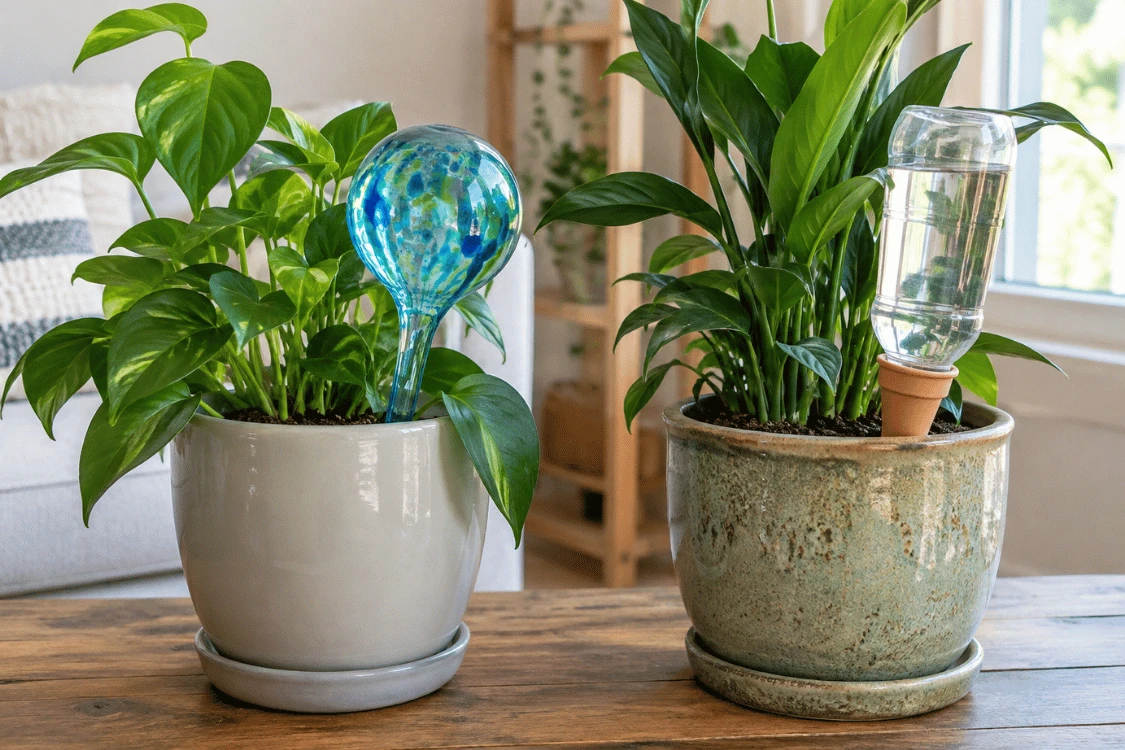
Watering globes are best when you want a compact, decorative reservoir for one small or medium pot. Watering spikes are more flexible: depending on their design, they may use a larger bottle, an external water container or an adjustable outlet. Neither is automatically better. The right choice depends on the mechanism, reservoir capacity, plant, potting mix and how long you will be away.
Both products can reduce the need for frequent hand watering, but neither can diagnose what a plant needs. Before choosing one, identify exactly how it stores and releases water.
What Is the Difference Between a Watering Globe and a Watering Spike?
A watering globe, also called a watering bulb, is normally a closed bulb-shaped reservoir with a narrow stem. The user fills the reservoir and inserts the stem into the potting mix. Glass globes are decorative and make the remaining water easy to see.
A watering spike is a broader product type. It may be:
- an integrated reservoir with a pointed outlet;
- a plastic or ceramic spike that accepts an inverted bottle;
- a porous ceramic cone connected by tubing to a separate reservoir; or
- an adjustable dripper attached to a bottle or water line.
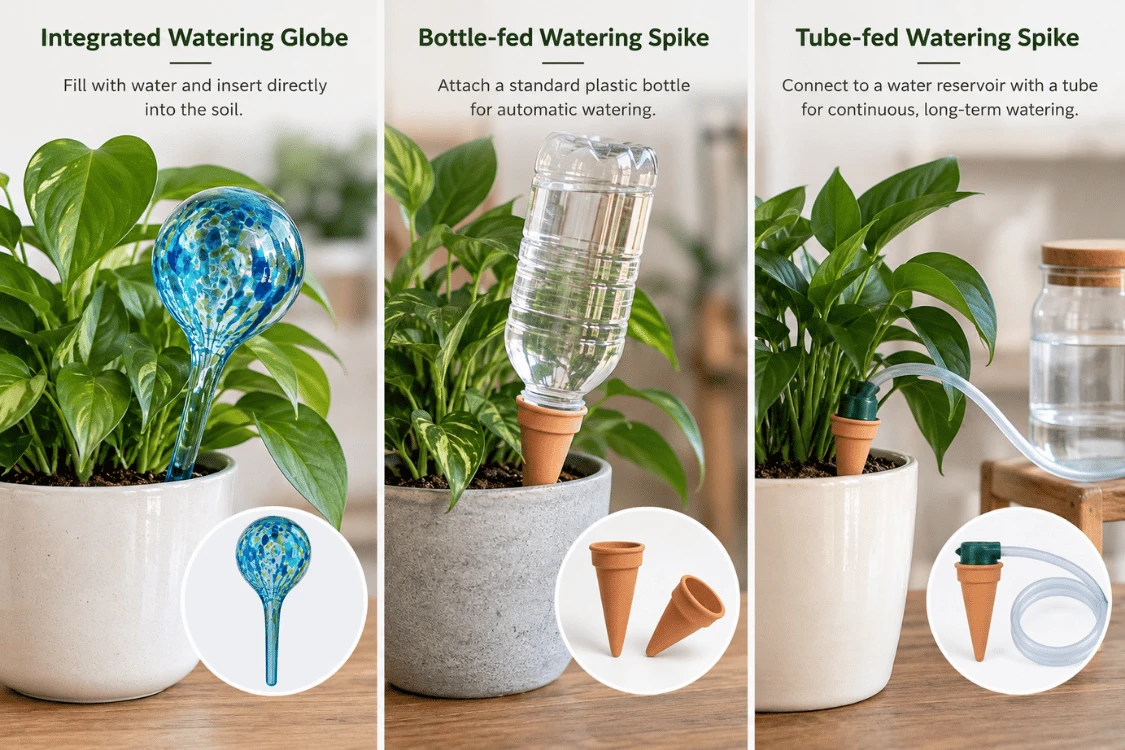
This distinction matters. A decorative glass product may be sold as a "globe," "bulb" or "spike" even when its mechanism is almost identical. EDAR's Frog Shape Glass Watering Globes and Pineapple Shape Glass Watering Spike, for example, both have an integrated glass reservoir and a stem inserted into the growing medium. Compare the structure and specifications, not just the product name.
Watering Globes vs Watering Spikes at a Glance
| Decision factor | Integrated watering globe | Bottle-fed spike | Porous ceramic or tube-fed spike |
|---|---|---|---|
| Water source | Built-in bulb | Separate bottle fitted to the spike | External reservoir or bottle, depending on design |
| Typical strength | Compact appearance and visible water level | Reservoir size can be changed when compatible | Can separate the reservoir from the pot or release through porous material |
| Main limitation | Fixed capacity; glass versions may break | A large bottle may look top-heavy or fit poorly | More parts and setup variables |
| Flow adjustment | Usually not directly adjustable | Some models include a valve or outlet control | Depends on cone, tubing and reservoir arrangement |
| Best fit | Decorative indoor pots and short-term support | Plants needing more capacity or an inexpensive refillable setup | Users prioritizing discreet reservoirs or a different release mechanism |
| Buyer checks | Capacity, glass thickness, stem opening, pack protection | Bottle compatibility, stability, adjustment range, leakage | Ceramic consistency, tube fit, priming instructions, reservoir position |
These are format-level tendencies, not performance guarantees. A well-matched globe can outperform a poorly fitted spike, and two spikes with different mechanisms may behave very differently.
Which One Should You Choose?
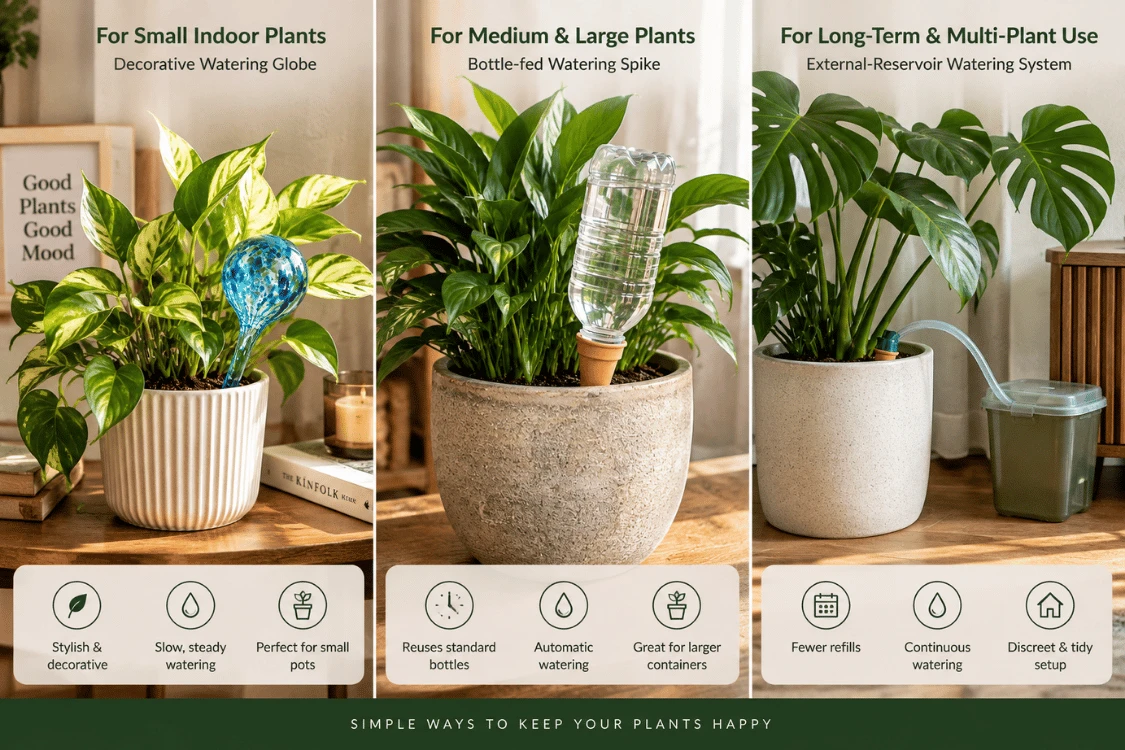
Choose a watering globe when appearance and simplicity matter
A globe works well when you want one self-contained piece with no external bottle or tube. The visible reservoir makes it easy to see whether water remains, and decorative shapes can complement an indoor pot display.
Check the filled weight before using a globe in a small or lightweight pot. The stem also needs enough unobstructed growing medium for insertion without forcing it against dense roots or the container wall.
Choose a bottle-fed spike when reservoir flexibility matters
A bottle-fed spike can provide more reservoir choices than a fixed globe, provided the device is compatible with the selected bottle. This format may suit medium or larger pots where a small decorative bulb would not hold enough water.
The trade-off is stability. A tall or heavy bottle raises the center of gravity and may lean in loose media. Verify the recommended bottle type, filled weight and installation depth. EDAR's Ceramic Waterer For Wine Bottle is a verified example of a ceramic format designed for a compatible bottle; its product page should be consulted for the selected commercial specification.
Choose a tube-fed or adjustable spike when control or reservoir placement matters
Some systems draw from a nearby vessel through a tube, while others use an adjustable outlet. They can keep a large reservoir off the pot and may offer greater setup flexibility. They also introduce more variables: tubing can kink or lose contact, flow settings can differ, and reservoir height may affect operation on certain designs.
Follow the instructions for the exact model. "Adjustable" does not by itself establish a repeatable flow rate under every potting and reservoir condition.
What Determines How Long the Water Lasts?
There is no reliable universal answer such as "one globe lasts seven days." Duration depends on both the water stored and the water released or used.
The main factors are:
- reservoir capacity;
- plant size and species;
- pot diameter and depth;
- light exposure;
- temperature and humidity;
- growing-medium structure and existing moisture;
- drainage and root condition;
- outlet size, ceramic porosity or flow setting;
- whether the reservoir leaks, clogs or loses contact with the medium.
University of Maryland Extension explains that potting media, humidity and temperature influence houseplant watering. Oklahoma State University Extension likewise notes that container irrigation frequency varies with temperature, plant selection, medium and container size.
For a rough planning measurement, fill the device to a known level, install it under normal room conditions and record how much water remains at the same time each day. Repeat the test at least once. This gives a plant-and-pot-specific observation; it is not a promise that the same duration will hold during hotter, sunnier or windier conditions.
Are Watering Globes and Spikes Suitable for Every Plant?
No. These products are easiest to match with plants that tolerate reasonably consistent moisture. They require greater caution with succulents, cacti and other plants that need the growing medium to dry substantially between waterings.
The device should supplement a suitable container and medium, not compensate for missing drainage or damaged roots. Virginia Cooperative Extension advises watering container houseplants thoroughly and allowing excess water to drain; it also warns against letting pots stand in water. A slow-release device does not remove the need for drainage.
Use the following questions before installation:
- Does this plant prefer evenly moist media or a distinct drying period?
- Is the pot already wet because of poor drainage?
- Is the reservoir appropriately sized for the plant and pot?
- Can the outlet be inserted without damaging major roots?
- Can the system be removed or adjusted if the medium stays too wet?
For a mixed plant collection, do not install identical devices and settings in every pot. Group plants by water demand and test each group separately.
How to Set Up a Watering Globe or Spike
- Water the plant normally if its medium is dry. Starting with evenly moistened, well-drained medium makes the test more representative and may prevent an unregulated outlet from releasing immediately into a very dry air gap.
- Check the outlet. Remove packing material and confirm that the opening, ceramic surface, valve or tube is clean.
- Make a pilot hole if the instructions permit it. This can reduce the chance of compacting medium into a narrow outlet or forcing a fragile stem.
- Fill and install the device as directed. Keep glass stems away from hard leverage against the pot wall.
- Check stability. Make sure the filled device cannot tip the pot or fall into a walkway.
- Observe the first several hours and the next day. Look for an empty reservoir, leakage, saturated media or no apparent transfer.
- Remove and clean between uses. Follow the material-specific instructions, especially for narrow glass stems, porous ceramic parts, valves and tubing.
Do not wait until departure day to discover how a device behaves. The University of Florida IFAS vacation plant care guide recommends setting up and testing vacation-watering systems in advance.
Why Did the Reservoir Empty Too Quickly-or Not at All?
A fast-emptying device may have been installed in very dry or loose media, may have an unrestricted air path, may be leaking, or may simply be too small for the demand. A device that does not empty may have a blocked outlet, poor media contact, a kinked tube or an unsuitable reservoir position.
Start with four checks:
| Symptom | First check |
|---|---|
| Globe empties soon after insertion | Look for cracks, leakage, a large air channel or very dry media |
| Water level does not change | Check for compacted mix in the stem, blocked ceramic pores, a closed valve or kinked tubing |
| Pot stays saturated | Stop the device and check drainage, plant needs and flow setting |
| Bottle-fed spike leans | Use only a compatible reservoir and verify filled-weight stability |
Avoid "fixing" a blocked narrow stem with a hard object that could crack glass. Use the cleaning method specified for the product. EDAR's Why A Watering Globe Empties Too Fast Guide address this intent in more detail.
How to Test a Device Before a Vacation
Run the system through the same number of days you expect to be away, if possible. Use the actual pot, plant, reservoir and planned position.
- Inspect the plant for existing water stress, pests and drainage problems.
- Install the device and record the starting water level.
- Check the medium and reservoir daily without changing the setup.
- Record when a refill becomes necessary.
- Repeat under similar light and temperature conditions.
- Choose backup care if the trip is longer than the demonstrated interval.
Do not increase capacity with an oversized bottle unless the spike and pot remain stable. For valuable or moisture-sensitive plants, a tested device plus a person who can check the collection is safer than relying on an untested accessory.
What Should Retailers, Importers and Private-Label Buyers Compare?
For buyers, the key task is to convert a decorative concept into a complete, testable specification. The following checklist is for product development; it is not a claim that every EDAR model includes every feature.
| Specification | Questions for the supplier or sample test |
|---|---|
| Product mechanism | Is it an integrated globe, bottle-fed spike, porous cone or adjustable dripper? |
| Reservoir capacity | What is the usable fill volume, measured by the agreed method? |
| Dimensions and filled weight | Will it remain stable in the intended pot size and growing medium? |
| Material | What material is used for the reservoir, spike, valve, tube and seals? |
| Outlet | What are the opening dimensions or flow-control features? |
| Bottle compatibility | Which bottle necks, sizes and filled weights are supported? |
| Ceramic consistency | How will porosity or water-release variation be sampled and assessed? |
| Glass protection | How are stems separated and cushioned during transport and retail handling? |
| Instructions | Do they explain filling, insertion, testing, cleaning and plant limitations? |
| Claims | Is any stated duration tied to defined test conditions rather than presented as universal? |
| Pack configuration | Are piece count, spare parts, colors and assortment ratios unambiguous? |
| Private-label artwork | Are warnings and setup diagrams readable in the target-market languages? |
Sample testing should use more than one potting medium and pot size. Record reservoir loss, leakage, breakage, blockage, stability and ease of cleaning. If a pack includes assorted shapes or colors, agree the assortment tolerance before production.
EDAR's Micro Irrigation range includes several watering-device formats. Final material, size, packaging, MOQ and customization details should be confirmed against the selected item and quotation rather than inferred from this guide.
FAQ
Q: Are watering globes better than watering spikes?
A: Not universally. A watering globe is a simple, decorative integrated reservoir. A watering spike can offer a larger or external reservoir and, on some designs, flow adjustment. Choose by mechanism, capacity, plant needs and stability.
Q: How long does a watering globe last?
A: There is no fixed duration for all globes. Capacity, plant size, pot, growing medium, light, temperature, humidity and outlet behavior all affect how quickly the water is used or released. Test it in the actual pot before relying on it.
Q: Can I use a watering globe for succulents?
A: Use caution. Many succulents need a substantial drying period, so continuous moisture may be unsuitable. Check the species, drainage and medium, and test conservatively rather than assuming a slow-release device is safe.
Q: Should I wet the soil before inserting a watering globe?
A: If the plant is due for water, begin with normally watered, drained and evenly moistened medium, then install the globe according to its instructions. Very dry media and air gaps can make release less predictable.
Q: Can a watering spike use any bottle?
A: No. Bottle neck fit, seal, capacity and filled-weight stability depend on the design. Use only bottle types and sizes confirmed as compatible with that spike.
Q: Do watering globes prevent overwatering?
A: They do not guarantee it. A mismatched reservoir, poor drainage, an unsuitable plant or an excessive release rate can keep the medium too wet. Monitor the plant and stop the device if saturation persists.
Q: Are glass or plastic watering devices better for retail?
A: Glass offers clarity and decorative appeal but requires breakage-resistant packaging and handling. Plastic is lighter and may support adjustable or bottle-fed designs, but material thickness, fit and appearance still need sample testing. The better option depends on the target range and price point.
Choose the Mechanism Before the Shape
Choose a watering globe for a compact, visible and decorative reservoir. Choose a compatible bottle-fed spike when capacity matters, or a tube-fed or adjustable design when reservoir placement and control are the priorities. Then test the complete setup with the actual plant, pot and medium.
Explore EDAR's Watering range for product options. For a retail or private-label project, share the intended pot size, device mechanism, material, reservoir requirement, pack configuration and target market so the specification can be reviewed accurately.


