

Why Does a Watering Globe Empty Too Fast? Flow Factors and Solutions
Leave a message
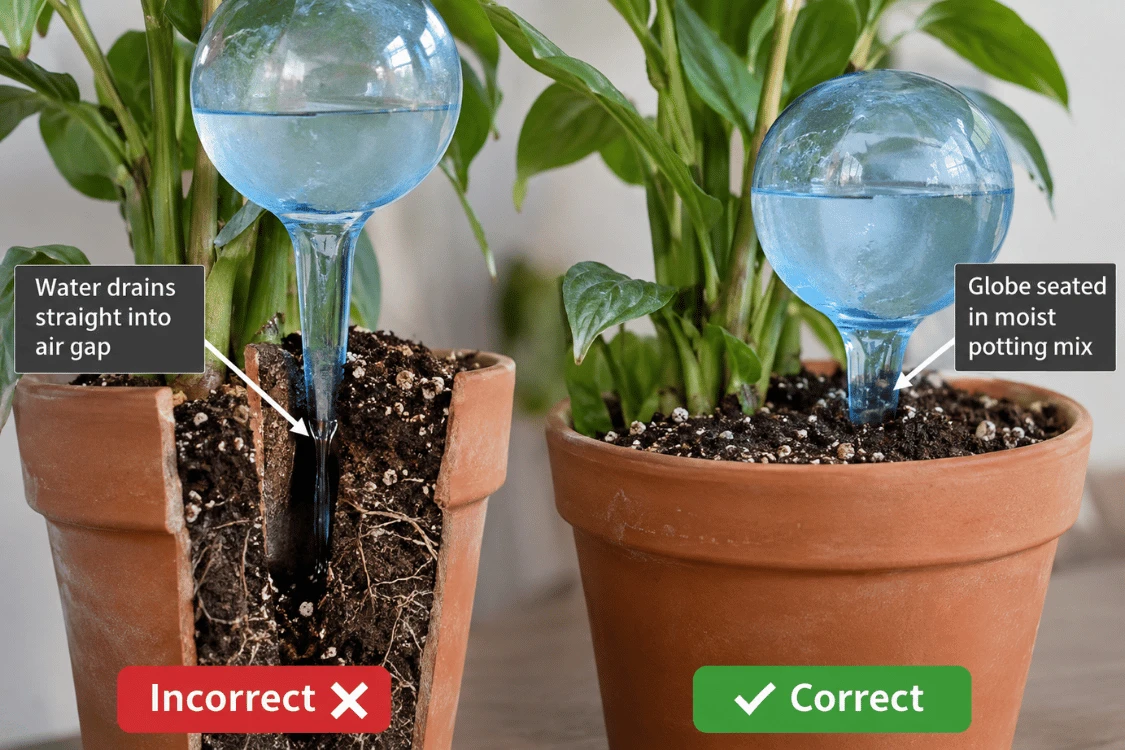
A watering globe that empties within minutes or a few hours usually has a setup or product problem: the globe may be cracked, the stem may have an unrestricted air path, or the outlet may not be in firm contact with the potting mix. If it releases water normally but runs out sooner than expected, the reservoir may simply be too small for the plant, pot and growing conditions.
Start by checking how quickly the water disappeared and what happened to the potting mix. That distinction is more useful than assuming every empty globe has the same fault.
Quick Diagnosis: What Does "Too Fast" Mean?
| Observation | Most likely category | First action |
|---|---|---|
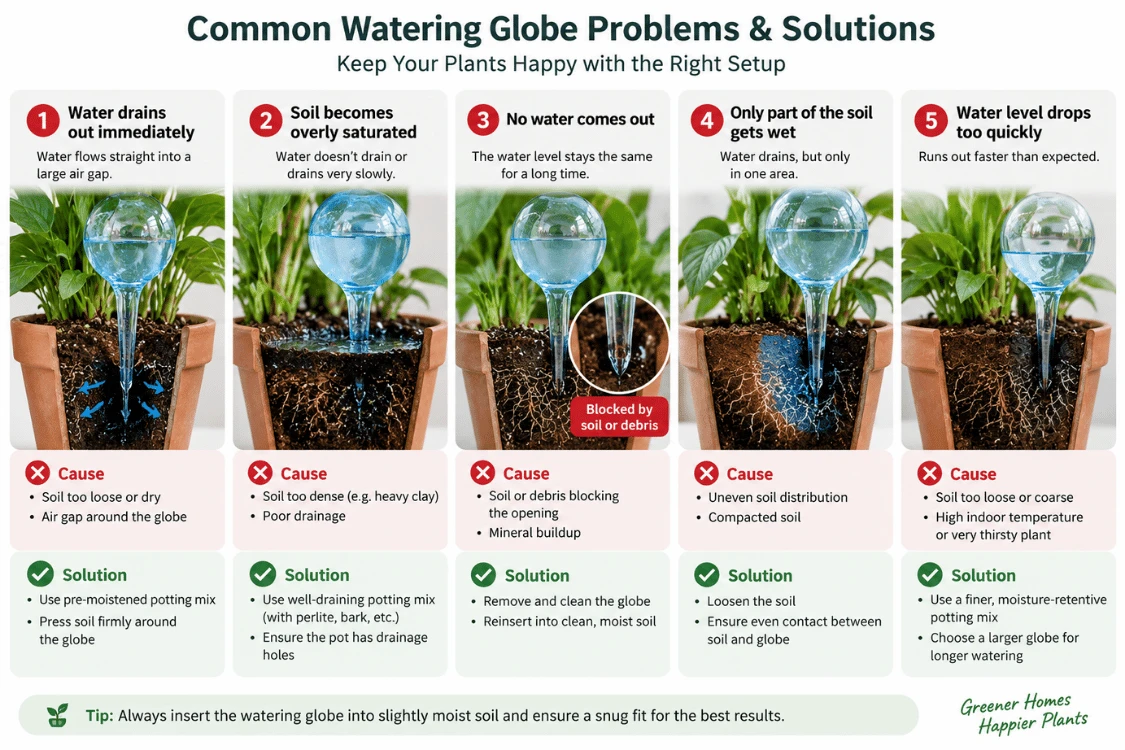
| Globe empties during installation or within minutes | Leak, crack, open air channel or poor media contact | Remove it, inspect the glass and repeat the setup only after correcting the cause |
| Globe empties within several hours and the pot is saturated | Excessive discharge or unsuitable setup | Stop using it until drainage, outlet contact and product condition are checked |
| Globe lasts for a period but not as long as expected | Capacity-to-demand mismatch | Review plant size, pot, medium, light, heat, humidity and reservoir capacity |
| Globe is empty but much of the root zone remains dry | Water may have followed a narrow channel or released in the wrong position | Check placement and moisture distribution before refilling |
| Water level barely changes | Blocked stem or insufficient contact | Remove and clean it according to the product instructions |
There is no universal number of days that proves a globe is working correctly. A stable release interval in one pot may change after the plant grows, the season changes or the pot is moved.
How a Watering Globe Releases Water
A standard watering globe is an integrated reservoir with a narrow stem placed upside down in the growing medium. It is not a calibrated irrigation emitter, and the plant does not literally "drink only what it needs" from the bulb.
Release depends on the complete setup:
- the reservoir and stem remaining intact;
- the size and shape of the outlet;
- how air can enter the inverted reservoir;
- contact between the outlet and the growing medium;
- the structure and moisture of that medium; and
- water demand from the plant and its environment.
EDAR's guide to watering globes vs watering spikes explains the main product mechanisms. This troubleshooting guide focuses on integrated globes and bulbs. Bottle-fed, porous ceramic and tube-fed spikes can fail for different reasons.
Seven Reasons a Watering Globe Empties Too Fast
1. The globe or stem is cracked
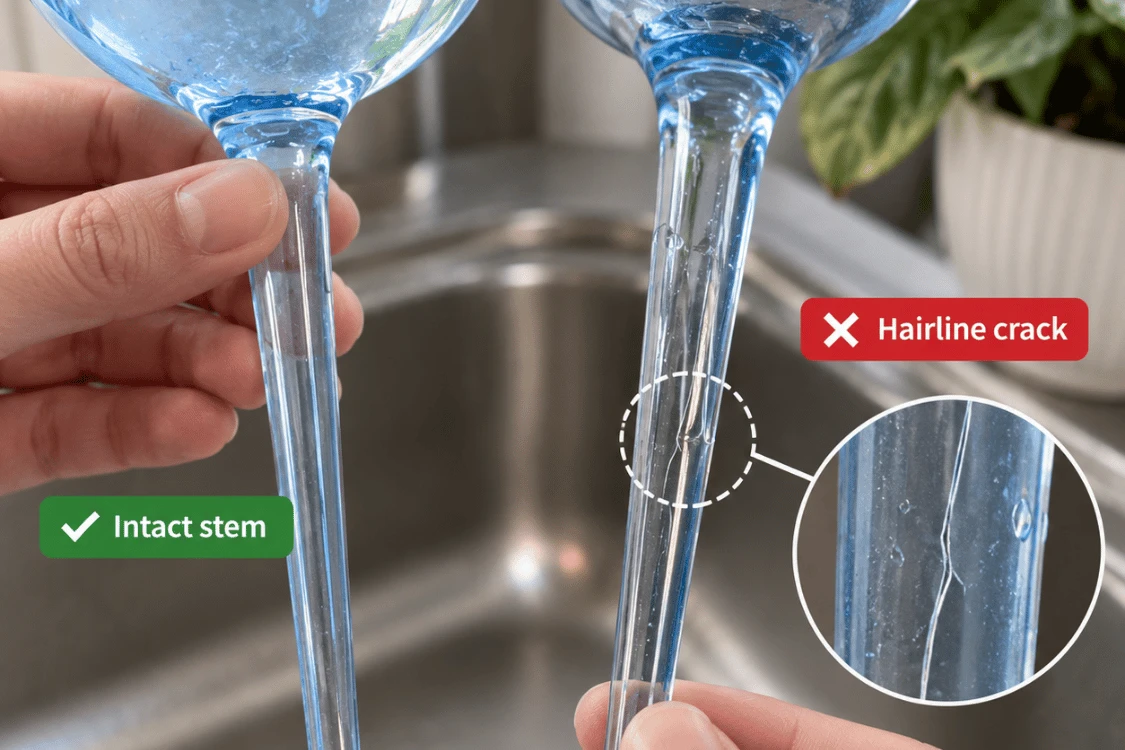
A hairline crack can admit air or allow water to escape somewhere other than the intended outlet. Glass damage may be difficult to see when the globe is decorative or wet.
Remove the globe and inspect it over a sink in good light. Pay particular attention to the narrow stem, the junction between stem and bulb, and any area that contacted a hard pot rim. If the product leaks through the glass rather than the opening, stop using it. Do not repair a plant-watering reservoir with an adhesive unless the product supplier explicitly provides an appropriate repair method.
2. The stem sits in a large air channel
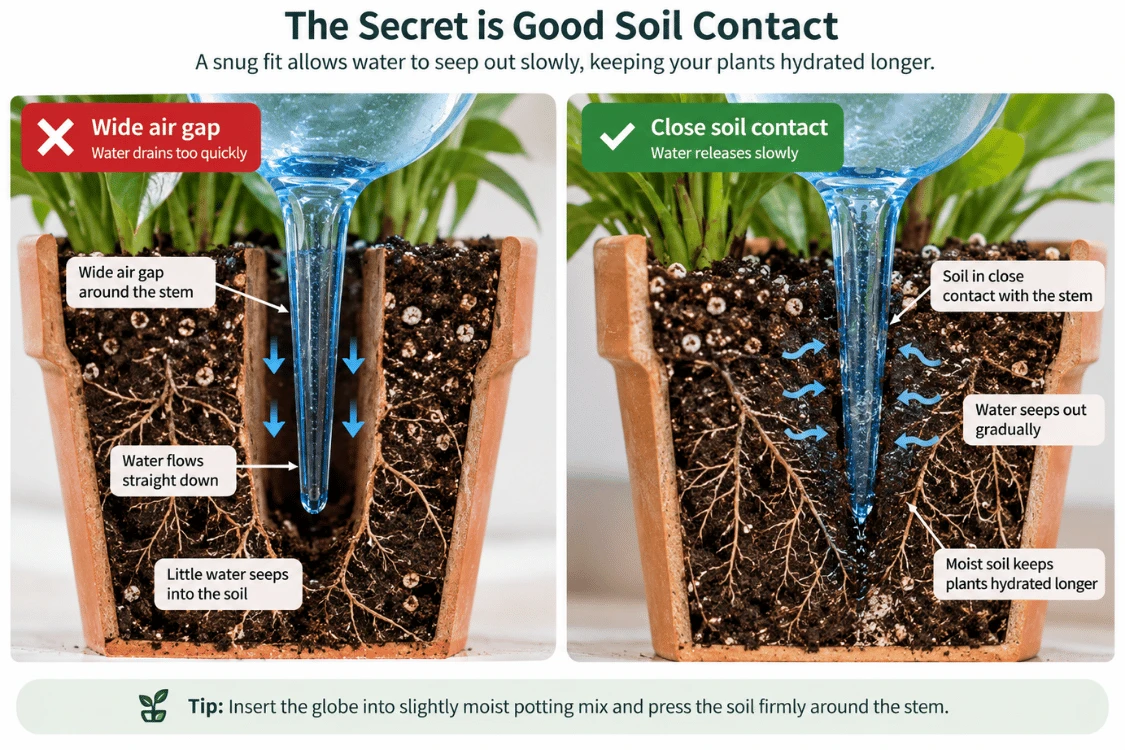
If the installation hole is much wider than the stem, the outlet may remain surrounded by air instead of growing medium. Water can then leave freely while air enters the reservoir.
Make only the smallest pilot hole allowed by the product instructions. Insert the globe into a position where the medium can contact the stem without forcing or levering fragile glass. A globe that wobbles in a wide cavity needs a different position or a corrected setup.
3. The potting mix was extremely dry
Very dry growing medium can produce an irregular first release. It may contain gaps and may draw water unevenly, especially if it has pulled away from the pot wall.
If the plant is due for water, water it normally first and allow excess water to drain. Then install the globe in evenly moist-not waterlogged-medium. This creates a more repeatable starting condition and makes it easier to identify whether the globe itself is leaking.
The University of Maryland Extension notes that potting media, humidity and temperature all influence houseplant watering. It also recommends watering according to plant need rather than following a fixed calendar.
4. The medium is very coarse, loose or uneven
A chunky bark-heavy mix, a recently repotted loose mix and a dense root-bound pot create different contact around the same stem. Large particles or voids can leave an easy air path, while dense material can block the opening.
Do not solve this by changing to an unsuitable mix merely to make the globe work. The plant's root health comes first. If the plant needs a highly open medium, a different watering mechanism may be more predictable than an integrated narrow-stem globe.
5. The outlet is unusually large or inconsistent
Two decorative globes that look similar may not have identical stem openings. Outlet geometry is a product variable, and handmade or poorly controlled openings may create inconsistent results across a set.
For a household user, compare the suspect globe with another unit under the same controlled setup. For a buyer, measure and record outlet dimensions during sample approval rather than evaluating only shape and color.
Do not improvise by stuffing cotton, paper, soil or other loose material into the stem. A homemade restriction can clog, contaminate or release unpredictably, and it prevents a fair assessment of the product.
6. The reservoir is too small for the demand
A globe can function normally and still empty sooner than expected. Large plants, extensive foliage, active growth and warm or dry conditions can increase water use. Small, shallow and porous pots can also lose moisture faster.
Oklahoma State University Extension explains that container irrigation frequency varies with temperature, plant selection, medium and container size. It also notes that small, shallow and porous containers tend to dry more quickly.
If the globe empties gradually and the plant remains healthy, measure the actual refill interval before calling the device faulty. The better solution may be a larger compatible system, a second device only if the pot can use it safely, or another watering method.
7. The environment changed
A globe tested in a cool room may behave differently after the pot is moved to stronger light, a warmer window, a balcony or a windy location. Seasonal plant growth also changes water demand.
Repeat the test whenever the plant, pot, medium or location changes. Never treat a previous refill interval as a permanent product guarantee.
A Safe Step-by-Step Troubleshooting Method
Step 1: Remove the globe and check the plant
If the potting mix is saturated, stop the device and allow conditions to return to the range appropriate for that plant. Confirm that the pot has functional drainage and that water is not standing in the saucer.
Step 2: Inspect the reservoir and stem
Fill the globe over a sink and look for leakage from any place other than the intended opening. Check for cracks, chips and an irregular outlet. Do not push a hard tool through a glass stem.
Step 3: Check the growing medium
Look for a gap between the mix and pot wall, a large installation cavity, heavy compaction or dense roots. These conditions change water movement and may indicate that the plant needs broader care rather than a globe adjustment.
Step 4: Start from an even moisture condition
If appropriate for the plant, water normally and let the container drain. Install the clean globe only after free water has stopped leaving the pot. Do not add a globe to a container that is already persistently wet.
Step 5: Reinstall without creating a wide channel
Choose a position with enough medium depth and without a major root or hard pot wall directly beneath the stem. Use a narrow pilot hole only when the product instructions permit it. Seat the globe firmly enough for contact but never force glass.
Step 6: Mark and observe the water level
Record the starting level and time. Check after one hour, several hours and the following day. Also check moisture distribution in the pot rather than judging by the reservoir alone.
Step 7: Change one variable at a time
If the globe still drains rapidly, use the same globe in a comparable pot or compare a second globe in the same setup. Changing the globe, pot, plant, medium and location at once will not reveal the cause.
How to Make a Watering Globe Last Longer
The goal is not to force the slowest possible release. It is to create a stable system that suits the plant.
Use these corrections in order:
- Replace any cracked or damaged globe.
- Correct an oversized installation hole or choose a better insertion point.
- Start with evenly moist, drained medium when the plant is due for water.
- Confirm that the outlet is clean and in appropriate contact with the medium.
- Reduce avoidable heat or wind exposure only if the new location still suits the plant.
- Match reservoir capacity and product type to the actual pot and absence period.
- Test the full setup before relying on it during travel.
Do not restrict the outlet with an untested plug and do not remove the pot's drainage. Slower discharge is not an improvement if it creates stagnant, continuously wet conditions.
What If the Globe Empties but the Soil Is Still Dry?
An empty reservoir does not prove that water was distributed through the root zone. The water may have followed a narrow channel, escaped beside the pot wall, or discharged near a drainage path.
Check moisture in more than one location and at more than one depth. If the area beside the stem is wet but the wider root ball remains dry, repositioning may help. A severely dried or water-repellent mix may require normal top or bottom watering to re-wet it evenly; a watering globe should not be used as the only corrective tool.
When Should You Stop Using the Globe?
Remove the device when:
- the growing medium remains saturated;
- the plant requires a pronounced drying period;
- the pot has poor drainage;
- the globe is cracked, unstable or difficult to insert safely;
- the stem repeatedly clogs or drains immediately despite correct setup; or
- testing shows that its capacity cannot cover the required interval.
Watering globes can be useful for compatible potted plants, but they cannot correct root damage, unsuitable potting mix or a container without drainage.
What Retailers and B2B Buyers Should Test
For importers, distributors, garden centers, e-commerce sellers and private-label brands, "slow release" is not a complete specification. Test the device under stated conditions and define how variation will be evaluated.
| Test item | What to specify or record |
|---|---|
| Product mechanism | Integrated reservoir and stem, distinguished from bottle-fed or porous ceramic products |
| Usable capacity | Agreed fill method and measured volume |
| Outlet | Opening dimensions, shape and unit-to-unit variation |
| Glass condition | Chips, cracks, wall consistency and stem alignment |
| Leakage | Whether water escapes anywhere except the intended outlet |
| Release test | Pot size, medium, starting moisture, plant or no-plant control, temperature, humidity, light and observation period |
| Stability | Filled weight, insertion depth and tipping risk in the intended pot |
| Cleaning | Whether the opening can be cleaned using the supplied instructions without damaging the stem |
| Packaging | Separation, cushioning and drop/transport validation appropriate to the target channel |
| Instructions | Filling, insertion, first-use monitoring, drainage warning, cleaning and breakage precautions |
| Claims | Any stated duration tied to defined test conditions rather than presented as universal |
A useful sample programme includes several units from more than one production sample, not one attractive prototype. Record immediate leaks separately from normal reservoir loss, and do not average a failed unit into the same result without identifying the failure.
EDAR's Frog Shape Glass Watering Globes and Pineapple Shape Glass Watering Spike are both verified examples of integrated glass-reservoir formats. Their names differ, which is why buyers should specify mechanism, capacity, dimensions and outlet rather than purchasing by the word "globe" or "spike" alone. Confirm final commercial details against the selected item and quotation.
FAQ
Q: Why did my watering globe empty immediately?
A: The most likely causes are a cracked globe, an oversized air gap around the stem, poor contact with the growing medium or a very dry and uneven setup. Remove the globe, inspect it for leakage and reinstall only after correcting the cause.
Q: Should I wet the soil before inserting a watering globe?
A: If the plant is due for water, begin with normally watered, evenly moist medium and allow excess water to drain before installation. Do not add a globe to already saturated soil.
Q: How long should a watering globe last?
A: There is no universal duration. Reservoir capacity, outlet, plant size, pot, growing medium, temperature, humidity, light and starting moisture all affect the refill interval. Test the actual setup instead of relying on an unsupported day count.
Q: Can I plug the opening to make the globe drain more slowly?
A: Do not add cotton, paper, soil or an improvised plug unless the manufacturer specifically instructs it. A loose restriction can clog, contaminate or release unpredictably. Correct the setup or choose a different mechanism.
Q: Why is my watering globe empty but the plant is still dry?
A: Water may have followed a narrow channel instead of spreading through the root zone. Check moisture at several locations and depths, then correct the placement or re-wet a severely dry mix using an appropriate normal watering method.
Q: Can a watering globe overwater a plant?
A: Yes. A cracked globe, excessive discharge, poor drainage or an unsuitable plant can keep the medium too wet. A globe does not guarantee protection from overwatering.
Q: Why does the same globe last longer in one pot than another?
A: Pots differ in size, material, drainage, root mass, growing medium and environment. Those variables change both water release and plant demand, so identical refill intervals should not be expected.
Q: How should a retailer test watering globes?
A: Use multiple units under documented conditions. Measure capacity and outlet dimensions, inspect for cracks and leakage, record the medium and starting moisture, monitor release over time, test stability and cleaning, and validate protective packaging.
Diagnose the System, Not Just the Empty Bulb
If a watering globe drains in minutes, inspect for damage, air gaps and poor media contact. If it lasts for a while but empties sooner than expected, compare capacity with the plant, pot, growing medium and environment. A repeatable test is more useful than a universal promise.
Explore EDAR's Micro Irrigation range and broader Watering range for different product formats. For a retail, wholesale or private-label project, share the intended mechanism, pot size, capacity requirement, pack configuration and target market so the specification can be reviewed accurately.


